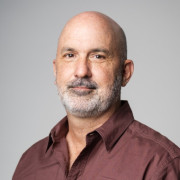
Diener, an American researcher recruited to work in Finland, reminds us that borders are integral to the global system.


"It is incredible to think that in the 1990s, notions of a borderless world and the end of the nation state were readily bandied about," says Alexander Diener, Professor of Critical Border Studies. To him, current news headlines are a constant reminder that borders are still integral to the global system and that they have an impact on the lives of people around the globe.
"To best understand and manage borders, both scholars and policy-makers must recognise that novel technologies currently and have always altered human relationships with space and place. This requires new ways of understanding and engaging relationships between the global, regional, and local."
Diener is one of the eleven international top researchers who received funding through the Academy of Finland’s PROFI9 programme to transfer to Finnish universities to work as professors and establish research groups there. Diener, who transferred here from the University of Kansas, started working at the Karelian Institute of the University of Eastern Finland in early June 2026.
"The PROFI9 funding opportunity was too good to pass up. The Karelian Institute and the University of Eastern Finland are highly regarded in border studies and human geography."
Diener doles out high praise for the Karelian Institute, acclaimed for its contributions to border research, whose researchers he already knows from prior long-term collaboration.
"I knew the institution to be a warm and vibrant setting for an academic career."
Planted in local sports and culture from the get-go
The American professor has felt warmly welcome in Joensuu and has already had his first encounter with the national sport of Finland.
"I attended my first Finnish Baseball game with a “newcomers to Joensuu” group around the end of May."
Having moved to Finland from the United States, Diener says he has settled well in his new home base of Joensuu. Both the university and the City of Joensuu have helped with the practical arrangements of his move.
"My first days were spent not only being guided through logistics of resettling, i.e., apartment set-up, office technology, bank account, etc., but also with lunches, dinners, and coffees."
In Diener’s opinion, the capital of the easternmost region of Finland is a vibrant city offering many possibilities that combines its warm atmosphere with the ease of living.
"Nature’s proximity is, of course, a boon beyond measure and I look forward to exploring the forests, rivers, and lakes."
Diener has been immersed in the music, dance, and literature of North Karelia from his first days in Joensuu, as he attended the Finnish Cultural Foundation’s annual celebration and grant award ceremony.
"I very much look forward to future events of this sort, as it was as educational as it was entertaining."
Research group currently recruiting members
Diener considers it his mission to undertake research that influences policy and expands knowledge in pursuit of a more just and peaceful world.
"It is my sincere hope that, through this professorship, I can help continue the rich tradition of scholarship in border studies at UEF and even enhance the global profile of the Karelian Institute and the university."
Diener is forming a new research group at a time when borders in Europe and around the world are animating headlines. In particular, the work of the team will involve exploring how borders influence conflicts and how they facilitate networks within and between societies and components of societies.
"One must remember that borders are integral to both the mediation and facilitation of movement. Borders filter in accordance with human values and societal interests."
At present, the research team is recruiting a post-doctoral researcher and two doctoral students. More positions are expected to open in the near future.
"Our intent is to engage in research that both impacts and informs."
Border research explores how to build a more just and peaceful future
Previously, Diener has studied migration, urban landscape change, infrastructure development, and place attachment, among other topics.
"Each of these topics center on relationships between place and identity and, by extension, the way borders shape political, social, economic, cultural, and environmental conditions. I see relevance in such research and a prospect of both better understanding our bordered world and how we might steer toward a more just, peaceful, and equitable one."
Diener points out that the world is full of varied forms of bordering that are used not only to signal but also to enact control.
"Understanding the tension between attempts to geographically structure control and the capacity and desire to transcend it is at the core border studies. I would say that anyone interested in fences between private properties to the transport of goods between states to the invisible lines that parse the oceans into national and international waters would find border studies a fascinating and exciting field."
Alexander Diener
Professor of Critical Border Studies, 1 June 2026–
- PhD (Geography), University of Wisconsin, 2003
- MA (Geography), University of South Carolina, 1995
- MA (International Relations), University of Chicago, 1994
Key roles and achievements
- Professor of Geography Department of Geography, University of Kansas, 2011–2026
- External Research Fellowship, University of Connecticut Humanities Institute, 2023–2024
- Visiting Research Scholar, Mongolia National University, 2018
- Senior Fellow, Harvard University, Davis Center for Russian and Eurasian Studies, 2015–2016