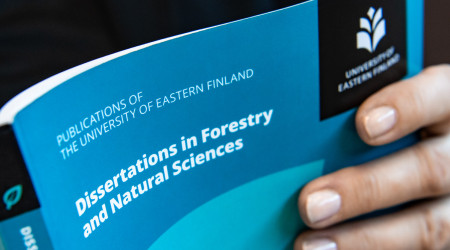
The doctoral dissertation in the field of Forestry will be examined at the Faculty of Science, Forestry and Technology, Joensuu campus.


What is the topic of your doctoral research? Why is it important to study the topic?
My doctoral research focuses on the genomic and metabolomic adaptation of two fungal pathogens: Phacidium infestans Karsten DSM 5139 and Colletotrichum salicis strain SimOT6. It investigates how these fungi respond to environmental stressors and interact with their hosts, with particular emphasis on cold tolerance, enzymatic machinery, virulence, and secondary metabolite production. Understanding these adaptations is crucial for both forestry and agriculture.
P. infestans thrives under snow on pine needles, tolerating bioactive compounds and freezing temperatures. In contrast, C. salicis has not previously been described as a potential endophyte; this study explores its possible endophytic behavior in Salix. The significance of this research extends beyond the laboratory, offering practical applications in forest disease management and industrial biotechnology.
What are the key findings or observations of your doctoral research?
Key findings of the research include the discovery that Phacidium infestans can survive and metabolize pine needles under snowpack conditions by producing cold-active enzymes, cryoprotectants, ice-binding proteins, and by breaking down plant defense compounds such as lignans and resin acids. Colletotrichum salicis SimOT6 was found to possess genomic traits suggesting a dual lifestyle, potentially switching between endophytic and pathogenic states depending on environmental cues.
The novelty and value of this research lie in sequencing the first complete genome of P. infestans, revealing its cold adaptation mechanisms and biotechnological potential. By uncovering the fundamental biology of this cold-adapted pathogen, the study opens new avenues for protecting boreal forests and harnessing fungal resilience for technological innovation. Additionally, it highlights the ecological plasticity of C. salicis SimOT6, contributing to a deeper understanding of fungal lifestyle transitions.
How can the results of your doctoral research be utilised in practice?
The results of this research have direct applications in forest pathology and biotechnology. The genome of Phacidium infestans reveals cold-active enzymes and ice-binding proteins that enable survival under snowpack, providing tools for early detection and management of snow blight in conifers. Notably, P. infestans produces industrially relevant enzymes such as GH11 xylanase, useful in biofuel production, paper bleaching, and food processing. Their cold- adapted properties make them ideal for energy-efficient processes operating at low temperatures.
On the other hand, the study of Colletotrichum salicis SimOT6, investigated here for the first time as a potential endophyte offers insights into fungal lifestyle transitions, supporting sustainable crop protection and the development of strains for biocontrol or plant growth promotion. Overall, the findings contribute to climate-resilient forest management and the discovery of novel enzymes for green technologies.
What are the key research methods and materials used in your doctoral research?
The research integrated genomic, metabolomic, and enzymatic approaches to study fungal adaptation. Whole-genome sequencing of Phacidium infestans and Colletotrichum salicis SimOT6 was conducted using PacBio technology. The genomes were annotated and analysed for virulence factors, carbohydrate-active enzymes (CAZymes), and biosynthetic gene clusters. Secreted proteins and effectors were predicted through bioinformatics pipelines. Metabolomic profiling of P. infestans using LC-MS/MS and DI-HRMS explored cold adaptation and chemical tolerance on pine needles. Enzyme activity was evaluated on substrate-specific media using halo assays, while GH11 xylanase from P. infestans was cloned and partially characterised in E. coli. Comparative genomics and phylogenetic analyses were applied to confirm species identity and infer ecological traits.
The doctoral dissertation of Chahira Zerouki, MSc, entitled Insights into the genomic and metabolomic adaptation of the fungal pathogens Phacidium infestans and Colletotrichum salicis will be examined at the Faculty of Science, Forestry and Technology, Joensuu campus. The opponent will be Professor Frederick O. Asiegbu, University of Helsinki, and the custos will be Emeritus Professor Ossi Turunen, University of Eastern Finland. Language of the public defence is English.
For more information, please contact:
Chahira Zerouki, [email protected], tel. +358 504 721 650